


- This event has passed.
The “Yu Fu” Forced Labor Civil Case – Third Hearing Court Observation
April 1, 2026
In September 2024, eight Indonesian fishers who had previously been employed on the Taiwanese distant-water fishing vessel Yu Fu filed a civil lawsuit before the Pingtung District Court with the assistance of lawyers and labor organizations. They sought payment of wage differentials in accordance with the minimum wage protections under the Labor Standards Act (LSA). The case was first heard in August 2025 and again in November 2025. However, due to the reassignment and retirement of the presiding judge, the proceedings were renewed, and a new judge conducted the first hearing of the case. The third hearing took place yesterday (March 31, 2026).
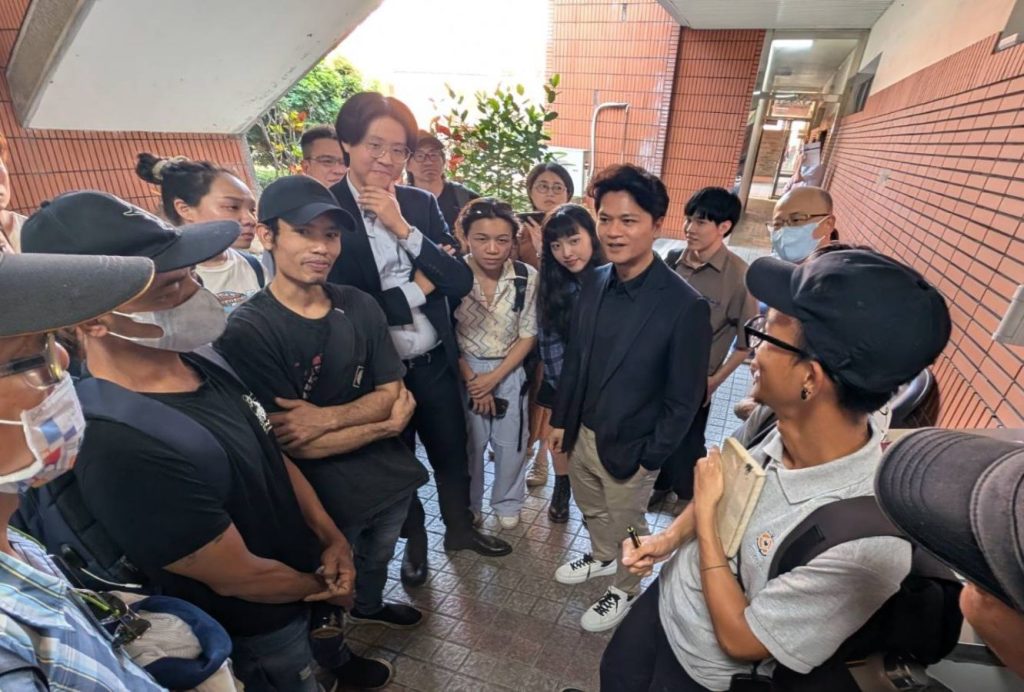
In addition to four of the plaintiff fishers appearing in court, members of the Taiwan Business and Human Rights Project, the Taiwan Association for Human Rights, the Taoyuan Migrant Workers’ Service Association, the Stella Maris International Service Center, Greenpeace, as well as legal professionals and individuals concerned with migrant worker issues in Taiwan, were present to observe the proceedings.
What Is at Issue in the “Yu Fu” Forced Labor Civil Case?
The eight plaintiff fishers worked aboard the Yu Fu between 2023 and 2024, during which they were subjected to 15 months of unpaid wages and treatment amounting to forced labor. Although the vessel owner later paid the outstanding wages after the case came to light, the calculation was based on a monthly wage of USD 550 per person (approximately NTD 17,800).
The vessel owner claimed that the USD 550 standard was based on the Act for Distant Water Fisheries and the Regulations on the Authorization and Management of Overseas Employment of Foreign Crew Members by Offshore Fishing Vessels (hereinafter the “Overseas Employment Regulations”). However, the legislature has never authorized the Ministry of Agriculture to set a minimum wage lower than that prescribed under the LSA. As such, the Overseas Employment Regulations, being merely administrative rules, cannot exclude the application of the LSA.
The vessel owner further argued that the Indonesian fishers in this case were “overseas employment” and therefore not subject to the LSA. However, under the principles of territoriality and flag state jurisdiction, foreign fishers working on Taiwanese-flagged distant-water vessels are deemed to be working within Taiwan’s jurisdiction. Accordingly, fishers working aboard the Taiwanese-flagged Yu Fu should be protected under the LSA.
Note: For further background on the “Yu Fu” civil litigation, please refer to the dedicated case webpage.
Do Overseas-Hired Foreign Fishers in Distant-Water Fisheries Fall Under the LSA?
During this hearing, the court focused on clarifying whether foreign fishers employed through overseas hiring arrangements in distant-water fisheries are still subject to the LSA.
Counsel for the plaintiffs reiterated the arguments based on territoriality and flag state principles, and emphasized that: “The LSA establishes minimum labor standards for all workers within Taiwan. As long as a worker performs labor within Taiwan’s jurisdiction, they are entitled to protection regardless of nationality. Any exclusion from the LSA must be officially announced by the Ministry of Labor. However, no such exclusion has ever been announced for distant-water fisheries.” Counsel further noted that while the Overseas Employment Regulations distinguish between offshore and onshore hiring, such distinctions merely regulate recruitment procedures and do not provide a legal basis for excluding the application of the LSA.
For migrant workers employed in Taiwan, certain categories such as domestic workers, have been excluded from the application of the LSA since January 1, 1999, by a formal announcement of the Ministry of Labor. As a result, domestic migrant workers are not protected under the LSA. However, this situation differs from that of distant-water fishers, who have never been officially excluded by the Ministry of Labor. Accordingly, fishers working aboard the Taiwanese-flagged Yu Fu should still be entitled to wages that comply with the minimum wage requirements under the LSA, rather than the USD 550 standard unilaterally set by the Ministry of Agriculture.
Does Forced Labor Constitute an Infringement of Personality Rights in Civil Law?
The court further addressed the plaintiffs’ claim for damages for non-pecuniary harm arising from alleged violations of personality rights due to forced labor. The judge requested clarification on the definition of “forced labor” and its connection to personality rights infringements.
In this case, the fishers were not only deprived of wages for 15 months, but also subjected to confiscation of identity documents, insufficient food and drinking water during voyages, excessive overtime, and other harsh working conditions. These circumstances indicate that the fishers were compelled to continue working against their will. Given their isolated and vulnerable situation at sea, with limited ability to seek help or leave, their freedom was clearly restricted, constituting forced labor.
The judge also referenced a non-prosecution decision issued by the Pingtung District Prosecutors Office on April 21, 2025. In response, plaintiffs’ counsel emphasized that the prosecution had not adequately examined whether the circumstances amounted to forced labor, focusing instead on whether the labor and compensation were grossly disproportionate. Counsel further argued that it is necessary for the plaintiff fishers to testify in court regarding their experiences of forced labor.
Continued Public Attention Is Encouraged
In recent years, international reports have repeatedly exposed incidents of forced labor involving Taiwanese enterprises. In 2020, Taiwan’s distant-water fisheries products were included for the first time in the U.S. Department of Labor’s “List of Goods Produced by Child Labor or Forced Labor,” and have since been listed three times.
The International Labour Organization (ILO) defined forced labor as early as 1930 as: “all work or service which is exacted from any person under the menace of any penalty and for which the said person has not offered himself voluntarily.” Among the ILO’s 11 indicators of forced labor are withholding of wages and abusive working and living conditions. These indicators serve as a warning that when workers continue working despite long-term or systematic non-payment or extremely low wages, it may not be voluntary but rather the result of coercion. Otherwise, why would migrant workers who urgently depend on wages continue working under such conditions?
International efforts to combat forced labor focus on addressing violations of human dignity. In Taiwan, however, such issues have often been reduced to mere wage disputes, overlooking their deeper human rights implications. This case highlights the need for Taiwan to align with international human rights standards, which would also help maintain the global competitiveness of its distant-water fishing industry.
The next hearing is scheduled for June 9, 2026 (Tuesday) at 4:10 PM at the Pingtung District Court. Members of the public are welcome to attend and continue observing how the judiciary addresses forced labor issues.