

Civil Society Monitoring Network Releases Report on Human Rights Impacts of Taiwanese Businesses in Thailand
March 27, 2026
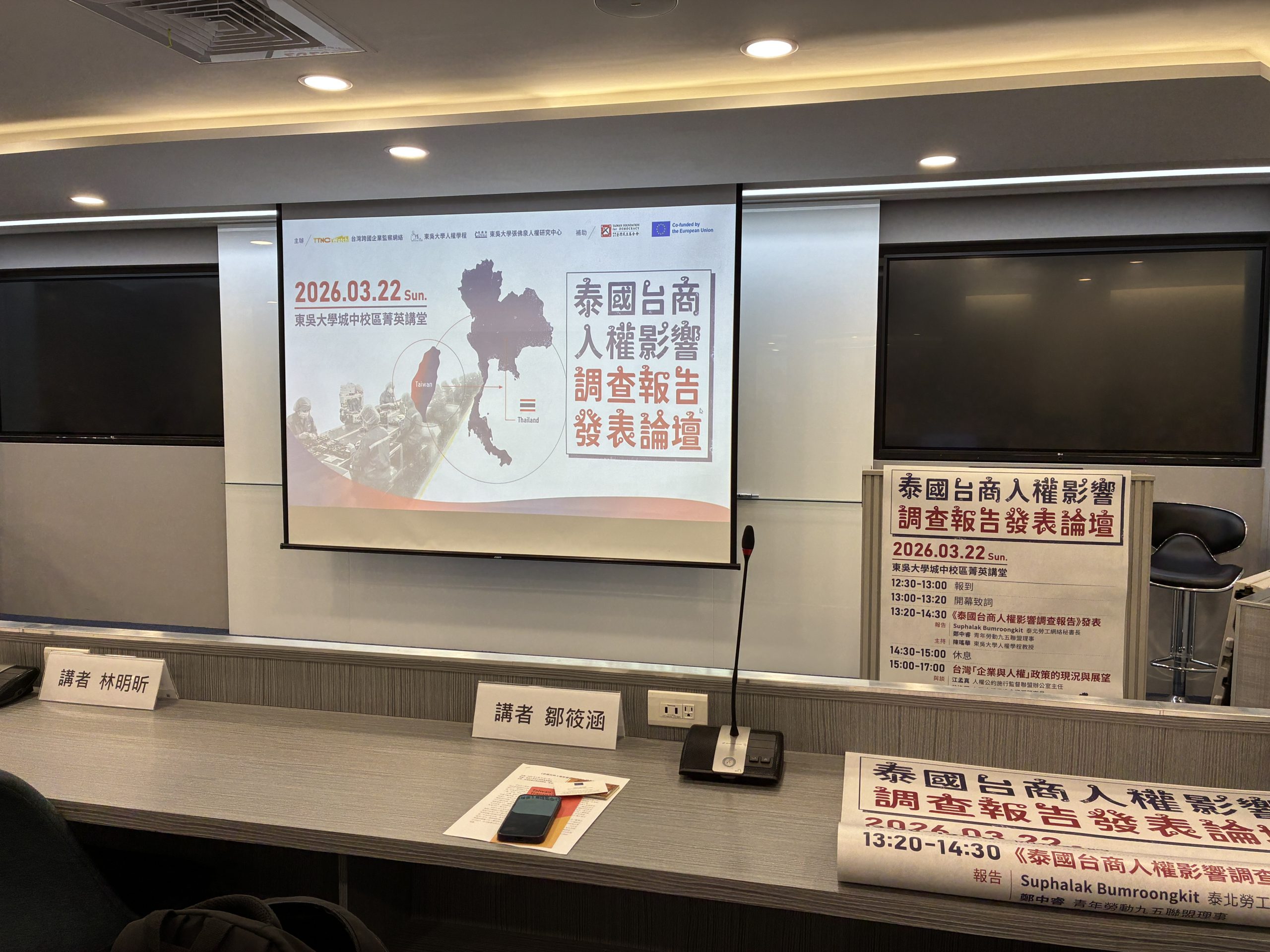
On March 22, the Taiwan Transnational Corporations Watch (TTNC Watch) held a forum to launch the “Human Rights Impact Report on Taiwanese Businesses in Thailand.” The report reveals the human rights impacts of Taiwanese enterprises operating and investing in Thailand, and calls on the government to strengthen oversight of Taiwanese companies’ responsibilities in their overseas investments and value chains.
The event also invited Minister without Portfolio Ming-Hsin Lin of the Executive Yuan, Deputy Head of the European Economic and Trade Office Lukas Gajdos, and Executive Secretary Hsiao-Han Tsou of the National Human Rights Commission to share their perspectives and respond to discussions on the development and importance of business and human rights in Taiwan.
About the Human Rights Impact Report on Taiwanese Businesses in Thailand
The report covers a research period from May to July 2025. Its methodology includes qualitative interviews with factory workers, tracking relevant judicial cases, and analysis of existing literature.
According to the forum, Taiwan’s investment in Thailand has long been concentrated in the manufacturing sector. From 2007 to 2025, manufacturing accounted for 62.1% of Taiwan’s total investment in Thailand, with electronic components, as well as computer, electronic, and optical product manufacturing being the primary categories.
The report selects three representative companies from different industries, electronics, rubber, and apparel, as case studies. Preliminary findings indicate that the main human rights impacts are concentrated in the following areas:
- Restrictions on the formation and operation of labor unions
- Unsafe and unhealthy working conditions
- Lack of transparency in corporate governance
TTNC Watch has already contacted the companies identified in the report and has begun receiving responses and explanations. The full report is expected to be released in due course.
Taiwan Lacks Guidance on Human Rights Impacts of Overseas Business Operations
The United Nations Guiding Principles on Business and Human Rights (UNGPs) state that governments should clearly communicate to all business enterprises within their territory and/or jurisdiction the expectation that they respect human rights throughout their operations. In practice, states should:
- Enact and enforce laws requiring businesses to respect human rights
- Ensure that company law and related policies do not hinder human rights protections
- Provide effective guidance to enterprises on how to respect human rights in their operations
- Encourage or require businesses to disclose their human rights impacts and mitigation measures
Among these, providing “effective guidance” is a critical component. In cross-border operations, companies often face differing legal frameworks and risk environments. In particular, when operating in conflict-affected or high-risk areas, the absence of clear guidance makes it difficult for companies to implement due diligence and risk management in a manner consistent with human rights standards.
Although the Taiwanese government has gradually established a policy framework on business and human rights, it still lacks clear guidance for Taiwanese companies operating overseas, with current efforts largely limited to the provision of information.
The first edition of the National Action Plan on Business and Human Rights (NAP), released in 2020, only proposed general directions under “administrative management of outbound investment” and did not provide concrete guidance. These directions included establishing a central-level inter-agency coordination mechanism, studying foreign regulatory models, strengthening review and supervision of outbound investments, and exploring whether regulations should apply to overseas Taiwanese businesses in areas such as anti-discrimination, labor, and environmental protection.
In addition, Executive Yuan’s communications on outbound investment emphasizes assisting overseas Taiwanese businesses in sustainable operations, including promoting corporate social responsibility, ESG (environmental, social, and governance), and net-zero emissions, while encouraging businesses to respond to global sustainability trends.
Finally, according to the draft “Taiwan Business and Human Rights Due Diligence Plan” released in October 2025, companies will be required, in phases, to conduct human rights due diligence on their own operations and global supply chains starting in 2026, and to disclose related information in sustainability reports beginning in 2027. However, the plan focuses primarily on disclosure requirements, and its initial phase applies only to large listed manufacturing companies with annual revenues exceeding NTD 50 billion.
As of February 2026, Thailand ranks first among countries receiving Taiwan’s approved outbound investment, totaling over USD 98 million. Ensuring that Taiwanese enterprises respect human rights in their overseas operations will therefore become a critical issue in the development of Taiwan’s economic policy.
企業監察組織發表在泰臺商人權影響報告
2026年3月27日
台灣跨國企業監察網絡在3月22日舉辦「《泰國台商人權影響報告》發表論壇」,揭露台灣企業在泰國營運和投資的人權影響,並期許政府加強管理臺灣企業在海外投資和價值鏈(value chain)的責任。
活動邀請亦邀請行政院政務委員林明昕、歐洲經貿辦事處副處長 Lukas Gajdos,以及國家人權委員會執行秘書鄒筱涵分享及回應企業與人權在台發展及重要性。
關於《泰國台商人權影響報告》
報告的調查期間為2025年5月至7月,研究方法包含工廠工人的質性訪談、相關司法案件追蹤,以及既有文獻資料分析。
根據論壇上的分享,台灣對泰國的投資長期以製造業為主。自2007年至2025年,製造業占台灣在泰國總投資的62.1%,其中又以電子零組件製造,以及電腦、電子產品與光學製品製造為主要類別。
該份報告選擇三家不同產業的指標性企業作為案例分析,涵蓋電子業、橡膠業與服飾業。初步調查顯示,相關人權影響主要集中於以下幾個面向:
- 工會組成與運作受到影響
- 不安全與不健康的勞動環境
- 公司治理透明度不足
目前,台灣跨國企業監察網絡已聯繫上報告中的企業,並陸續收到回覆與說明,完整報告內容預計後續公布。
臺灣缺乏企業在海外營運的人權影響指引
《聯合國企業與人權指導原則》(UNGPs)提,國家應向所有在其領土和/或管轄範圍內的企業,表明對其完整營運過程尊重人權的期待。在落實上,國家應該:
- 制定並執行要求企業尊重人權的法律
- 確保公司法與相關政策不阻礙人權保障
- 提供企業「如何在營運中尊重人權」的有效指引
- 鼓勵或要求企業揭露其人權影響與因應方式
其中,「提供有效指引(effective guidance)」是關鍵環節,因為企業在跨國營運中,往往面對不同的法規與風險環境,更甚者,企業在發生衝突、存在高人權風險地區如何做出尊重人權的決策,若缺乏清楚指引,將難以落實盡職調查與風險管理。
臺灣政府雖已逐步建立企業與人權相關政策架構,但對於臺灣企業在海外的營運缺乏明確指引,並停留在提供資訊。
2020年發布的《企業與人權國家行動計畫》(NAP)第一版,僅在「跨國投資行政管理」項目提議政府運作方向,並無提供任何指引。其運作方向包含建立中央層級的跨部會協調機制、研究其他國家制度、強化對外投資審查與監督機制,及探討在反歧視、勞動與環境等領域,是否有必要規範海外台商和是否有用。
而在行政院對外投資摘要新聞中,提及將持續協助海外臺商永續經營,針對企業社會責任、ESG(環境、社會、公司治理)及淨零排放等議題,協同駐組,向海外臺商宣導提醒因應國際趨勢、永續經營。
最後,根據政府在2025年10月公布的《臺灣企業供應鏈尊重人權方案》(草案),分階段要求企業自2026年針對自身與全球供應鏈進行人權盡職調查,並在2027年起的永續報告書中揭露相關資訊。然該《人權方案》著重於揭露訊息,且第一階段僅限年營業額超過500億元的大型上市櫃製造業。
泰國列居臺灣在2026年2月核准對外投資總金額國家別的第一位,高達9千8百多萬美元。如何確保我國海外企業尊重當地人權的責任,將成為臺灣經濟政策發展的重要課題。