

- This event has passed.
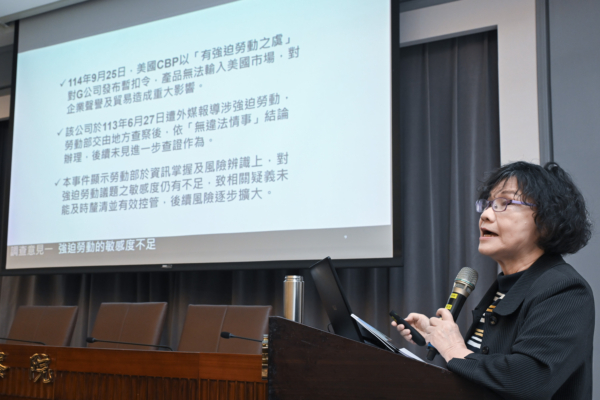
Giant Implicated in Forced Labor Allegations; Control Yuan Members Urge Ministry of Labor to Review Policies
[Epoch Times, April 23, 2026]
(Reported by Chang Huai-jen, Epoch Times correspondent in Taipei, Taiwan)
U.S. Customs authorities accused Taiwan’s Giant Manufacturing Co., Ltd. (Giant) last year (2025) of being involved in “forced labor,” and temporarily detained bicycles and related components manufactured at its Taiwan facilities. Control Yuan members Wang You-ling, Lai Chen-chang, and Chi Hui-jung initiated an investigation. Following the approval of the investigation report, the members stated on the 23rd that Taiwan’s labor human rights regulations and institutional framework still fall short of the standards set by the International Labour Organization (ILO), urging the Ministry of Labor to review and improve its policies.
The investigation found that the company had previously been reported by foreign media as having suspected links to forced labor. Although the Ministry of Labor had been aware of the related public concerns and referred the matter to local governments for inspection, it subsequently relied solely on the investigation results provided by local authorities to conclude that “no violations were found.” No further review or verification mechanism was established, reflecting insufficient sensitivity in identifying risks related to forced labor.
The Control Yuan members pointed out that Taiwan’s current system still primarily relies on existing labor regulations as the basis for assessment and has not fully incorporated ILO forced labor indicators as standards for risk identification and inspection. This creates a gap between domestic “legality assessments” and international “compliance requirements,” particularly in areas such as debt bondage, wage withholding, and living conditions.
They further noted that this case highlights how companies may still be deemed to pose supply chain risks under international human rights standards even if they comply with domestic laws. Without incorporating ILO indicators and a comprehensive supply chain risk governance framework at the institutional level, and relying instead on piecemeal regulatory adjustments, it may be difficult to effectively respond to global human rights governance trends or to fully identify diverse and often hidden forced labor risks within supply chains.
The members also stated that although the Taichung City Government conducted inspections after receiving reports, the scope of these inspections largely focused on intermediary fees, dormitory conditions, and other formal aspects, rather than conducting substantive investigations based on ILO indicators. Many cases were closed on the grounds of “no further issues after mediation” or “migrant workers absconded,” with no evidence of ongoing follow-up or subsequent labor inspection mechanisms, indicating that such inspections were largely superficial.
Accordingly, the Control Yuan members concluded that local governments lack sufficient capacity to identify forced labor risks, while the Ministry of Labor has failed to adequately fulfill its supervisory responsibilities. As a result, the overall inspection mechanism has become largely formalistic, and relevant risks have not been identified or addressed in a timely manner. This not only undermines the protection of workers’ rights but also increases the likelihood that companies will face international sanctions, as well as supply chain and reputational risks.
In addition, the members noted that although the company in question had established grievance mechanisms, in practice these still largely relied on existing government channels such as the 1955 hotline. However, this hotline primarily serves functions of receiving complaints and making referrals, which falls short of the internationally required internal, real-time grievance and remedy mechanisms within enterprises.
The members further stated that both the Ministry of Economic Affairs and the Ministry of Labor still have room for improvement in assisting enterprises in aligning with international human rights standards and in building grievance and remedy systems that meet international norms. Although the government has gradually promoted guidelines on the prevention of forced labor, due diligence mechanisms, and related legislative initiatives, in light of increasingly stringent global regulatory trends, there remains a need to accelerate the integration and implementation of these systems.
Editor: Cheng Hua
捷安特涉強迫勞動 監委促勞動部檢討
【大紀元2026年04月23日訊】(大紀元記者常懷仁台灣台北報導)美國海關去(2025)年指控台灣巨大集團(捷安特)涉「強迫勞動」,暫時扣留台灣廠所製的自行車與零組件。監委王幼玲、賴振昌、紀惠容啟動調查,監察院通過調查報告,監委23日指出,台灣的勞動人權法規與制度及國際勞工組織(ILO)公約仍存落差,促請勞動部檢討改進。
監委調查發現,該公司早已遭外媒報導涉及強迫勞動疑慮,勞動部雖已掌握相關輿情並交由地方政府查察,但後續僅依地方政府回復之調查結果,即認定「無違法情事」,未進一步建立複核或再查證機制,顯示對強迫勞動議題之風險辨識敏感度不足。
監委指出,台灣現行制度仍主要以既有勞動法規為判斷基礎,尚未全面導入ILO強迫勞動指標作為風險辨識與查核標準,使國內「合法性認定」與國際「合規性要求」之間產生落差,如抵債勞務、扣發薪資、生活條件等。
監委認為,此案突顯企業即使符合國內法令,仍可能因未符合國際人權標準而被認定具供應鏈風險。所以若未能從制度層面導入ILO指標及供應鏈風險治理架構,僅以個別法規修補方式因應,恐難有效回應國際人權治理趨勢,亦難完整辨識供應鏈中多樣且隱性之強迫勞動風險。
監委表示,台中市政府於接獲通報後雖有進行查察,惟查核內容多集中於仲介收費、宿舍環境及形式性事項,未依ILO指標進行實質調查。多數案件亦以「經協處後無疑義」或「移工失聯」為由結案,未見持續追蹤或後續勞動檢查機制,顯示查核作為流於形式。
因此,監委指出,地方政府對強迫勞動風險辨識能力不足,勞動部亦未善盡督導責任,使整體查核機制流於形式,相關風險未能及時辨識與處理,不僅影響勞工權益保障,亦提高企業面臨國際制裁、供應鏈與聲譽風險之可能性。
此外,監委也提到,本案顯示相關企業雖設有申訴機制,實務上仍主要依賴政府1955專線等既有管道,而該專線僅屬受理與轉介功能,與國際所要求之企業內部即時申訴與救濟機制仍有落差。
監委指出,經濟部及勞動部於協助企業接軌國際人權標準、建構符合國際規範之申訴與救濟制度方面,仍有精進空間。雖政府已陸續推動企業防制強迫勞動指引、盡職調查機制及相關法制作業研議,但面對國際監管趨勢持續強化,相關制度仍有加速整合與落實之必要。
責任編輯:鄭樺